Office Address
2nd Floor, Sri Ram Nagar, 21-1-45/4, Road, Akkarampalle, Tirupati
Andhra Pradesh 517507
Office Address

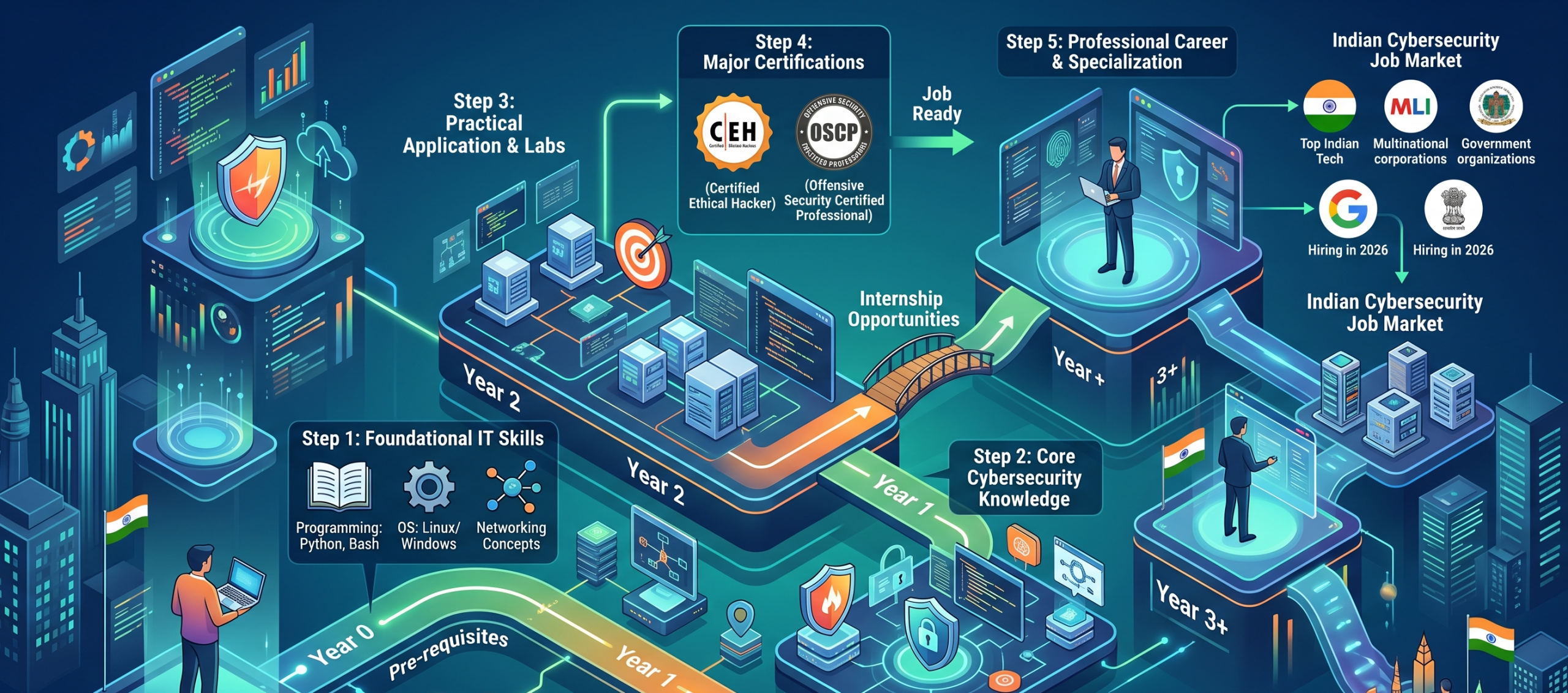
The digital landscape in India has undergone a seismic shift. As of 2026, with the full
implementation of the Digital Personal Data Protection (DPDP) Act and the emergence of
sovereign AI infrastructures, the role of a “White Hat” hacker has transitioned from a specialized
niche to a national necessity.
If you are starting from absolute zero, the journey might seem like a mountain to climb.
However, the path to a career in digital defense is more structured than ever. Thanks to the
availability of specialized cyber security training and high-quality cyber security online
courses, you can transition from a novice to a job-ready professional within 8 to 12 months.
This roadmap is your definitive guide to navigating this lucrative career path in India.
The 2026 Hacking Landscape: Why India is the Hub
India is currently the global nerve center for cybersecurity operations. With over 1.5 million job
openings projected by the end of the year, the industry is facing a massive talent crunch. Major
tech hubs like Bengaluru, Hyderabad, Pune, and the NCR region are no longer just looking for
degrees; they are hunting for demonstrable skills.
The Rise of AI-Driven Cyber Warfare
In 2026, hacking is no longer a purely manual process. Modern ethical hacking involves:
● Adversarial AI: Defending against automated malware that adapts in real-time.
● Automated Pentesting: Using AI agents to scan for vulnerabilities across vast cloud
networks.
● Deepfake Mitigation: Protecting corporate identities from synthetic media fraud.
Step 1: Mastering the Foundations (Months 1–2)
Before you can break a system, you must understand how it is built. In 2026, skipping the
basics is the fastest way to hit a career ceiling.
Step 2: Programming and Scripting (Month 3)
In 2026, a “point-and-click” security professional is obsolete. Automation is the standard of the
industry.
● Python for Security: Python is the primary language for exploit development and task
automation. Focus on libraries like Scapy for packet manipulation and Requests for web
testing.
● Bash Scripting: Essential for automating repetitive tasks on Linux servers.
● SQL Basics: Necessary to understand SQL Injection, which remains a top-tier threat to
Indian e-commerce and banking portals.
Step 3: Structured Professional Education (Months 4–6)
Self-learning is powerful, but the Indian job market highly values verified credentials. Enrolling in
a structured cyber security online training program provides a vetted roadmap and, more
importantly, a professional network.
What to Look for in 2026:
● Virtual Cyber Ranges: Ensure your cyber security training provides access to
sandboxed environments where you can practice real-world attacks legally.
● AI Security Modules: In 2026, your curriculum must cover securing AI models against
“prompt injection” and data poisoning.
● Industry Placement: Many Indian education platforms now offer “Pay After Placement”
models, which align the institute’s success with your own.
Step 4: Practical Application and “Proof of Work”
(Months 7–8)
Theory earns you a certificate; practice earns you a paycheck. In 2026, your “Proof of Work” is
your true resume.
Step 5: Navigating the Indian Job Market
By Month 9, you should be ready to apply. The 2026 salary trends for freshers who have
completed a comprehensive cyber security online course are among the highest in the IT
sector.
Entry-Level Roles to Target:
● Junior Pentester: Conducting vulnerability assessments for web applications.
● SOC Analyst (Tier 1): Monitoring real-time security alerts in a Security Operations
Center.
● Vulnerability Researcher: Identifying bugs in software code before they can be
exploited.
Salary Estimates (India 2026):
Experience Level Annual Salary Range (INR)
Fresher (0 Exp + Certification) ₹4.8 LPA – ₹7.5 LPA
Skilled Fresher (CTF/Bounties) ₹8 LPA – ₹12 LPA
Mid-Level (2–4 Years) ₹14 LPA – ₹25 LPA
Frequently Asked Questions
Conclusion: Take the First Step
Becoming an ethical hacker in India with zero experience is a marathon, not a sprint. By
following this roadmap—focusing on foundations, choosing structured cyber security training,
and building a practical portfolio—you can join the ranks of India’s digital guardians. In 2026, the
digital gates are open; it’s time to learn how to defend them
Our Courses : Artificial Intelligence & Machine Learning , Java Full Stack Development , Cyber Security & Ethical Hacking , DevOps & Cloud Engineering .