Office Address
2nd Floor, Sri Ram Nagar, 21-1-45/4, Road, Akkarampalle, Tirupati
Andhra Pradesh 517507
Office Address

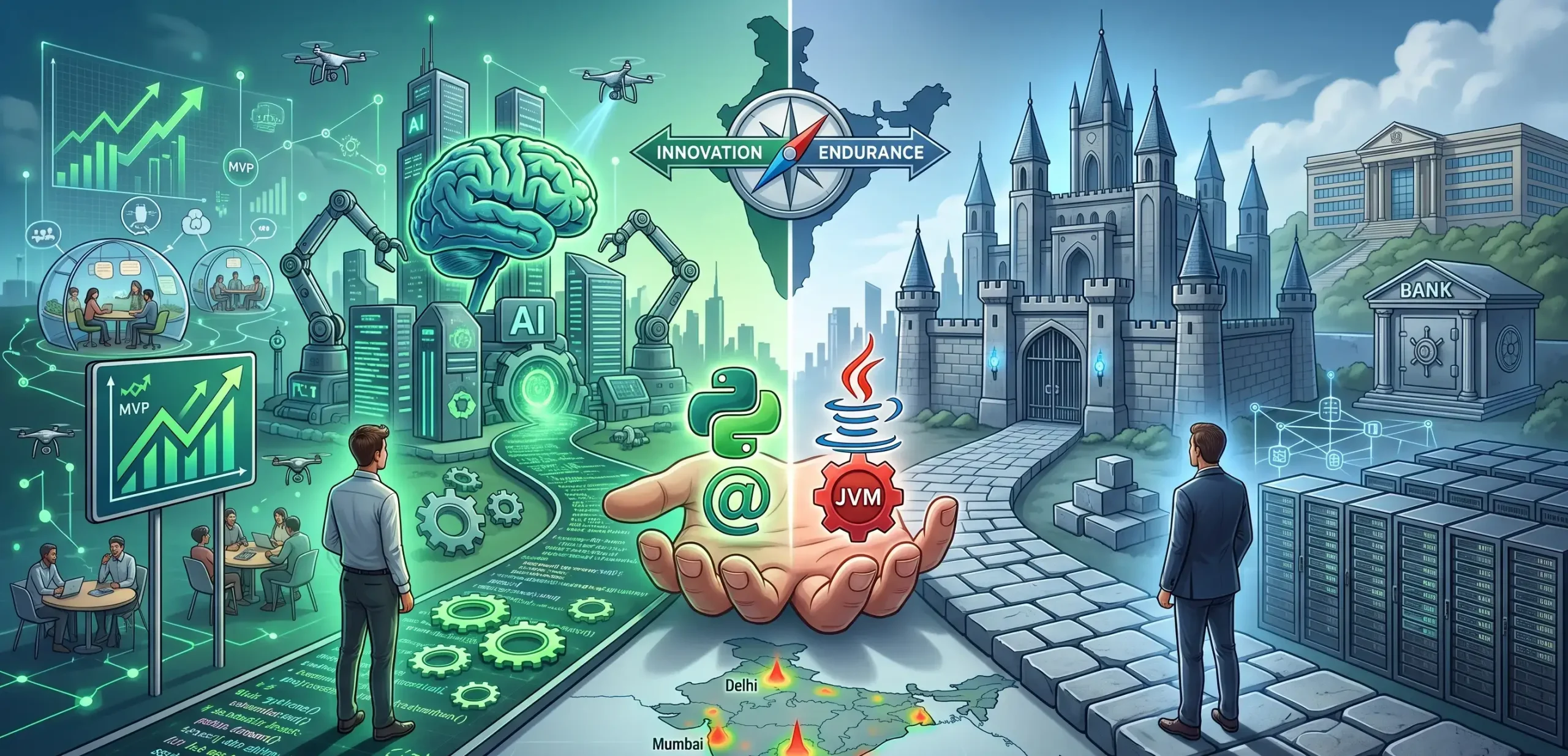
If you are looking at the tech scene in India right now, it is easy to feel like you are falling behind. Everyone is talking about AI, startups are hiring one day and laying off the next, and the old advice about just “learning to code” does not feel specific enough anymore. You might be sitting there wondering if you should stick with the classic reliability of Java or jump into the Python hype. To be honest, there is no perfect answer that fits everyone, but if we look at where the Indian job market is headed for 2026, the choice gets a bit clearer.
Here is the thing about Python. It is not just for people who want to build robots or predict the stock market. It has become the default language because it is just so easy to read. If you have ever looked at a block of code and felt like your brain was melting, Python will feel like a relief. It looks a lot like English. This might sound like a small detail, but when you are trying to find the best python course online, you want something that helps you build things fast.
In India, our tech industry used to be all about big service companies doing maintenance work for overseas clients. That is still happening, but now we have this massive wave of AI integration. Python is the language that powers almost every AI tool you see. If a company in Bangalore or Gurgaon wants to build a chatbot or an automated data tool, they are going to look for someone who knows Python. It is not just about being a “coder” anymore; it is about being someone who can use Python to solve a specific problem. That is why you see so many people looking for python online training courses lately. They are not just trying to learn a language; they are trying to stay relevant.
You might hear people say Java is old or “legacy,” but do not let that fool you. If you walk into a massive bank in Mumbai or a giant consultancy firm like TCS, they are still running on Java. Why? Because Java is like a tank. It is heavy, it is hard to move, but it is incredibly hard to break. It handles huge amounts of data and thousands of users at the same time without breaking a sweat.
That said, Java is a lot harder to learn than Python. The rules are strict. If you forget a semicolon or mess up a bracket, the whole thing just stops. It is not as “friendly” as Python. But here is the catch: because it is harder, there is often less competition for high-level Java roles. Everyone and their cousin is taking a python course online training program right now. Fewer people have the patience to truly master Java’s complex architecture. So, if you like the idea of working for a massive, stable corporation, Java might actually be your best bet.
So, which one should you pick? If I were starting from scratch in 2026, I would look at what I actually want to do every day. If you think data, machine learning, or even just building quick web apps is cool, then Python is the way to go. It gives you immediate results. You can find a solid python training program, spend a few months on it, and actually have projects you can show a recruiter.
On the other hand, if you want to build the backend of a banking app or work on massive Android projects, Java is still the king. But you have to be ready for a longer learning curve. You will not feel “productive” in Java as fast as you will in Python. To be honest, I have seen a lot of students get frustrated with Java because they want to build cool stuff right away, and Java makes you work for it.
Here is something nobody tells you: in 2026, recruiters in India are not just looking for someone who knows the syntax of a language. They want to know if you can use AI to help you write that code. Python is great for this because most AI coding assistants are really good at it. If you are taking a python course online, you should also be practicing how to use AI tools to debug your work.
I once tried to learn a new framework without any help, and it took me weeks. Nowadays, if you know the basics of Python, you can use an AI to help you move ten times faster. Companies know this. They would rather hire a Python developer who knows how to be efficient than a “purist” who insists on doing everything the slow way. This is a big shift in how Indian startups are hiring right now. They want speed.
You might be wondering which python online training courses are actually worth your money. Here is a bit of honesty: the most expensive course is not always the best one. A lot of people spend lakhs on “guaranteed job” bootcamps only to find out they could have learned the same thing on YouTube or a cheaper platform.
What you really need is a course that makes you build stuff. Do not just watch videos. If the course does not force you to open a code editor and struggle with a project, it is a waste of time. Look for training that focuses on the Indian context—things like building an e-commerce backend or a local data scraper. That is what will get you noticed in a stack of resumes.
In the end, you cannot really go wrong with either, but Python feels like the safer bet for 2026 if you want flexibility. It is the language of the future because the future is AI-driven. Java is the language of the present (and the past), which means it is stable, but maybe a bit less exciting.
If you are still stuck, try this: go find a free five-minute tutorial for both. See which one makes more sense to your eyes. If Python feels like a natural fit, then go all in. Find the best python course online that fits your budget and start building. The job market in India is tough, but it is also full of opportunities for people who actually know how to solve problems, regardless of which language they use to do it.
1. Is Python better than Java for freshers in India in 2026?
For freshers looking to enter high-growth fields like Data Science or AI, Python is superior. However, for those targeting traditional software engineering roles in large IT firms, Java remains highly valuable.
2. Can I get a job by only learning Python?
Yes, but you must pair it with domain-specific tools. For example, a data analyst needs Python plus SQL and Power BI (IMF, 2026).
3. Which language pays more in the Indian market?
Python-based roles in AI and Machine Learning generally offer higher starting salaries compared to entry-level Java roles, due to the specialized nature of the work.
4. How long does it take to learn Python through online training?
Most intensive python online training courses take 3 to 6 months to reach job-readiness, depending on your prior coding experience.
5. Is Java becoming obsolete because of AI?
Not at all. While AI favors Python for development, the infrastructure of the world’s largest companies is built on Java. It remains a “trustworthy” language for secure, large-scale systems (IEEE, 2026).
Our Courses : Artificial Intelligence & Machine Learning , Java Full Stack Development , Cyber Security & Ethical Hacking , DevOps & Cloud Engineering .





Thanks giving this information