Every year, thousands of engineering graduates across India ask: “How do I actually get a Java
developer job when I have no real work experience?”. The answer lies in moving beyond
theoretical knowledge and acquiring a specific, project-driven skill set through a comprehensive
Full java course.
In 2026, the Indian IT sector remains heavily reliant on Java for enterprise software, powering
the backends of banks, e-commerce platforms, and government portals. This guide provides a
step-by-step, EEAT-compliant strategy to help you land your first role.
- Why Java Remains the Safest Career Bet
Before committing to any path, a fresher must verify the market demand. In 2026, Java Full
Stack roles are consistently among the top three most-posted developer positions in India.
● High Salary Potential: Starting salaries for freshers in service-based companies range
from ₹8–12 LPA, while top-tier product companies offer ₹18–25 LPA.
● Structural Demand: Enterprise software in India is built on Java because of its stability
and security, ensuring long-term job security.
● Scalability: Java’s ecosystem, particularly Spring Boot, is the preferred choice for
microservices architectures in modern tech firms.
- The Skills That Actually Matter in 2026
Most freshers waste time on outdated concepts. To get hired, you need a Java course online
training program that focuses on these core pillars:
Core Java & Backend Foundation
● Java 8+ Features: Mastery of Lambda expressions, Stream API, and the Optional class
is non-negotiable.
● Spring Boot & Hibernate: These frameworks appear in over 80% of Java job
descriptions; you must know how to build REST APIs with them.
● Database Mastery: You should be proficient in SQL joins, subqueries, and Spring Data
JPA.
Full Stack Versatility
Companies are no longer looking for “pure” backend developers. They want candidates who
have undergone Java full stack training.
● Frontend Basics: Understand HTML, CSS, and JavaScript enough to build functional
interfaces.
● Modern Frameworks: Learn the basics of React.js or Angular to connect your frontend
to your Java backend
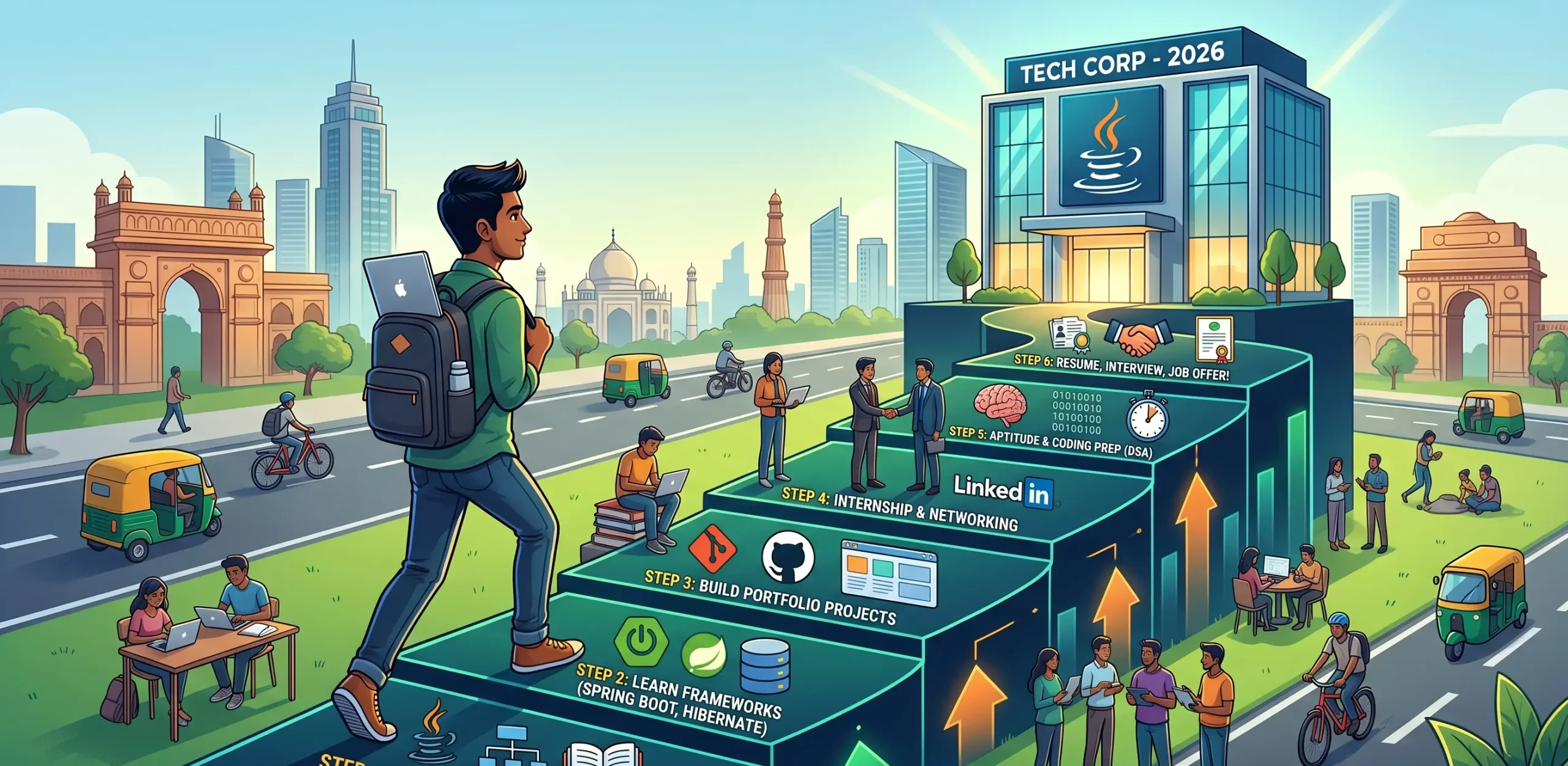
- Your 3-Month Roadmap to Job-Ready
A structured Java course online should follow a logical progression to get you interview-ready
in 90 days.
- Month 1 — Foundation: Master Core Java (OOPs, Collections) and Git. Build
console-based mini-apps.
- Month 2 — Frameworks: Dive into Spring Boot, Hibernate, and MySQL. Develop your
first complete REST API and test it with Postman.
- Month 3 — Full Stack & Portfolio: Add a React/Angular frontend to your API, deploy it
to a free hosting platform, and start intensive mock interview prep.
- The Portfolio That Gets You Shortlisted
In 2026, a GitHub profile with working projects is the single most effective tool for a fresher.
Ensure your Full java course includes these projects:
● E-Commerce REST API: Demonstrates your ability to handle JWT authentication and
security.
● Student Management System: Shows full CRUD (Create, Read, Update, Delete)
capabilities and database design.
● Appointment Booking System: Proves you can integrate third-party services like
JavaMail
- Certification and Placement Strategy
While skills are paramount, a Java course certification helps your resume pass automated
ATS (Applicant Tracking System) filters.
● Verified Credentials: A certificate from a recognized institute adds credibility to your
technical claims.
● LinkedIn Optimization: Recruiters in India search LinkedIn actively; your profile should
highlight your projects and your Java course online training.
● Referrals: Using an institute’s hiring partner network—such as Fingrow’s 180+
partners—can bypass cold applications and speed up the hiring process.
Frequently Asked Questions (FAQ)
- Can I get a Java developer job without any prior work experience? Yes. Most entry-level
Java roles in India are designed for freshers, prioritizing practical skill and “proof of work” over
work history.
- Is a B.Tech or BE degree mandatory for Java developer roles? While often required by
MNCs, many product startups now use skill-based hiring. A strong project portfolio can often
outweigh a degree gap.
- How long does it realistically take to get placed? A dedicated fresher following a
structured Java full stack training program can become interview-ready in approximately 3 to
4 months.
- What is the average starting salary for a Java fresher? In 2026, the range is typically ₹8
LPA to ₹18 LPA, depending on whether the company is service-based or product-based.
- Why should I choose Java over Python in 2026? Java remains the backbone of enterprise
software and high-volume backend roles in India, offering higher job stability and stronger
fundamental training.
Ready to Start Your Journey?
Join Fingrow’s Full java course with a “Pay After Placement” model. Gain your Java course
certification and access direct referrals to 180+ hiring partners today.
Our Courses : Artificial Intelligence & Machine Learning , Java Full Stack Development , Cyber Security & Ethical Hacking , DevOps & Cloud Engineering .