Office Address
2nd Floor, Sri Ram Nagar, 21-1-45/4, Road, Akkarampalle, Tirupati
Andhra Pradesh 517507
Office Address

So we are doing this again.
Every few years, a new technology shows up and the headlines go into full panic mode. When ATMs arrived, everyone said bank tellers were finished. When personal computers replaced typewriters, people thought office workers were done. Neither happened the way anyone predicted. And now here we are with AI, and the conversation is louder than ever.
To be honest, I understand why. This one feels different. AI is not just sitting in one industry quietly doing its thing — it is in your email inbox, your search results, your hospital, your kid’s school. So when someone asks “is this going to take my job,” that is not paranoia. That is a reasonable question that deserves a straight answer.
Here is the thing though. Most of the scary coverage is missing something important. And it is not the usual “do not worry, humans are special” comfort talk. It is actually more practical than that.
Your Brain Is Doing Something AI Still Cannot Do
This might sound like the kind of thing someone says just to make you feel better, but stay with me.
AI is genuinely good at pattern recognition. You give it enough data and it will find connections that would take a human analyst months to spot. That part is real and it is impressive. But there is a gap — a pretty significant one — between finding patterns in data and actually understanding what is going on. And that gap is where most human work happens.
Think about walking into a meeting and sensing something is off before anyone says a word. Maybe the silence lasts a beat too long. Maybe someone is smiling but their posture is completely closed off. You are processing hundreds of tiny signals at once without consciously thinking about it. You just know. AI can scan facial expressions and flag sentiment in text. But it does not know what to do with that information the way you do. It does not feel the shift in the room. It does not adjust.
That is not some mystical human superpower. It is just what happens when you spend a lifetime existing as a person around other people. AI does not have that. Not yet, and maybe not ever in the way that actually matters.
Emotional Intelligence Matters More Than People Think — Especially at Work
You might be thinking — okay but does emotional intelligence actually show up in real work, or is it just soft skills people talk about in HR meetings?
Here is what I keep noticing. The moments that actually move things forward at any job — closing a deal, handling an angry client, getting a skeptical team to commit to a direction — those moments are almost entirely emotional. Someone has to read the other person, adjust mid-conversation, say the right thing at the right time rather than the technically correct thing. That is not a task you can hand off. That is judgment, built from experience and a real understanding of people.
AI can tell you a customer is frustrated based on the words they used. It cannot tell you whether you should apologize, gently push back, or just let them finish talking. That call takes a person. It always will.
The Creativity Question — And This One Is More Complicated
To be straight with you, this is where a lot of takes go wrong in both directions.
AI does produce things that look new. Images, articles, code, music — it generates stuff that did not exist in that exact form before. So writing it off as not creative at all is not accurate. But here is what it is actually doing under the hood. It is remixing. Very sophisticated, very fast remixing, but remixing all the same. It works from patterns in everything it has already seen. It does not sit with a problem for three weeks, get stuck, abandon the approach, come back to it at two in the morning with a completely different angle, and arrive at something genuinely unexpected.
That messy, non-linear, slightly irrational process that humans go through when they are actually creating something — AI does not have that. The ideas that end up changing industries usually come from someone who understands a human problem deeply and is stubborn enough to pursue something that looks wrong to everyone else at first. That kind of stubbornness, that willingness to look foolish for a while — you cannot train a model on it.
So What Is AI Actually Useful For?
In other words — if it is not replacing humans, what is it doing?
Honestly, the most accurate description I have come across is this: AI is a very fast, very tireless assistant that does not need breaks and does not get bored. It handles the work that needs to get done but does not need a human behind it. First drafts. Summarizing long reports. Sorting through data looking for anomalies. Answering the same support question for the five hundredth time. That layer of necessary but repetitive work is where AI genuinely earns its place.
What that frees up — when teams actually think about it instead of just piling more output on top — is human time and attention for the parts that require a real person. The judgment calls. The relationship building. The moments where someone has to look another person in the eye and make a hard decision without all the information they would like to have.
That said, I have also seen teams where AI just creates more noise. More content, more output, more stuff sitting in the queue that nobody is sure what to do with. That is not augmentation. That is just more work with a fancier source.
Let Us Be Honest About the Jobs Side of This
Some roles will shrink. Some already are. If most of your job involves processing and organizing information that follows predictable patterns, AI is going to do a significant chunk of that. It is worth taking seriously instead of brushing off.
But new roles are emerging too. Prompt engineering did not exist five years ago. AI auditing — checking whether AI systems are producing fair and accurate outputs — is a growing field. People who understand both the human side of a problem and how AI tools actually work are increasingly hard to find and increasingly valuable.
The shift is real. It just does not look like a robot takeover. It looks more like a slow reshuffle of what work actually involves, and what skills end up mattering most.
Here Is What It Actually Means for You
The people who are going to do well through this are not necessarily the most technical. They are the ones who are clear about what they bring that a model cannot replicate.
Can you build genuine trust with people? Can you make a judgment call when the situation is ambiguous and the stakes are real? Can you take something half-formed and turn it into something that actually works? Those things are not going anywhere.
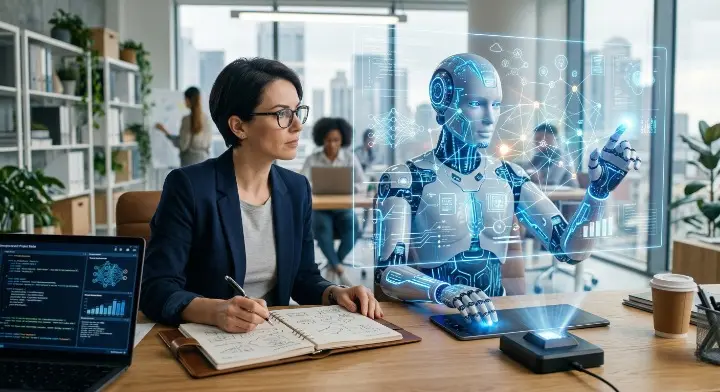
AI is a tool. A genuinely useful one — more capable than most tools we have had access to before. But it works best when a human is steering it, catching what it gets wrong, and handling the parts that actually require being a person in the world.
That is not a consolation prize. That is still the most important part of the job.