Office Address
2nd Floor, Sri Ram Nagar, 21-1-45/4, Road, Akkarampalle, Tirupati
Andhra Pradesh 517507
Office Address

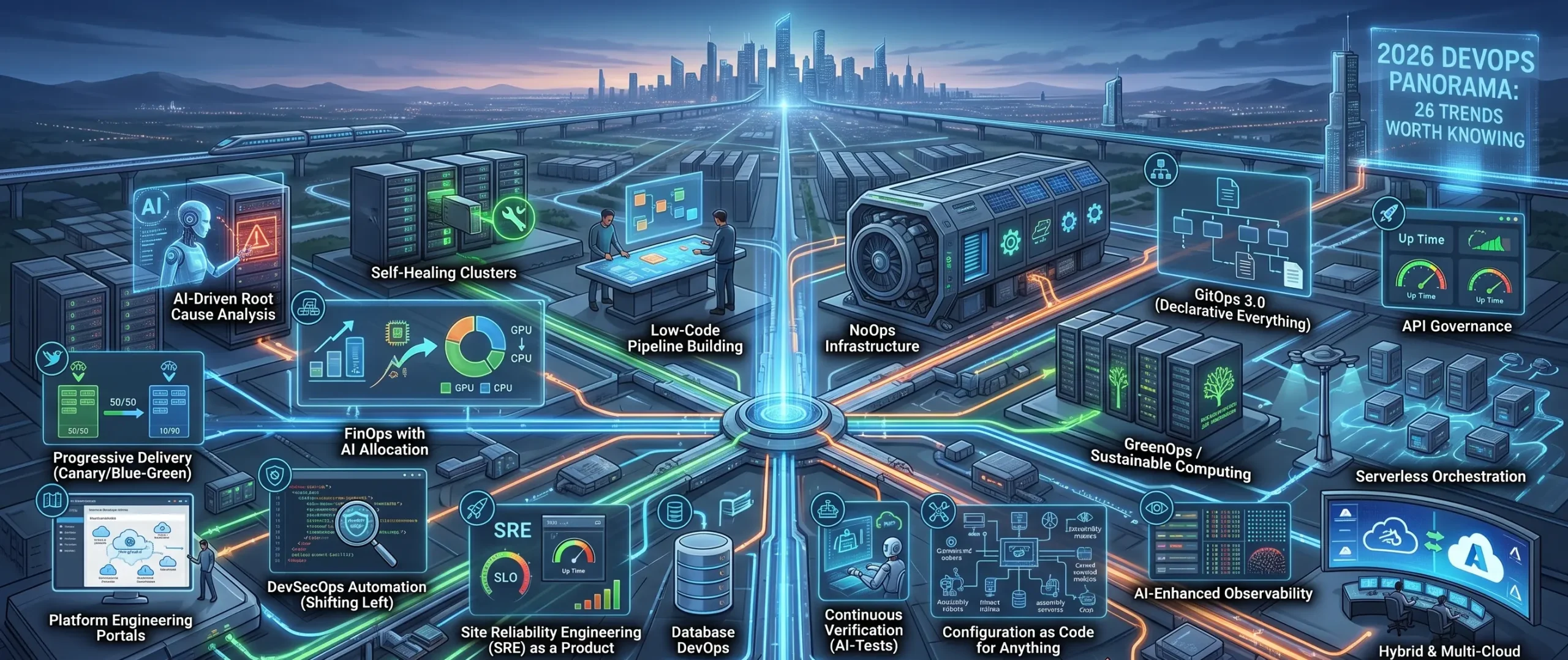
The divide in 2026 is not between teams that know about DevOps and teams that do not. It is between teams that actually built it into how they work and teams that just say they did.
Here is what is shaping the field right now.
What Is DevOps?
Developers wanted to ship fast. Operations wanted stability. The two goals created slow releases, painful handoffs, and a lot of blame when things broke.
DevOps closes that gap — shared ownership, automated pipelines, infrastructure treated like code. When it works, teams ship multiple times a day and recover from failures in minutes. When it fails, it is almost always because the organization bought the tools and skipped the culture change.
The 26 Trends
1. DevSecOps — Security checks — dependency scanning, secrets detection, static analysis — run inside the development pipeline from the start. Problems get caught when they are still cheap to fix, not after the release is already staged.
2. Serverless Computing — You deploy code. The cloud provider handles everything underneath. Pay only for what runs. Great for APIs, background jobs, and event-driven tasks. Not right for every workload — cold starts and execution limits are real constraints.
3. Microservice Architecture — Instead of one big codebase that takes everything down when it breaks, microservices are small independent services that each do one thing. Teams deploy without coordinating with everyone else. Tradeoff: distributed complexity. Worth it at scale.
4. AIOps — Modern infrastructure generates more telemetry than any human team can process. AIOps uses machine learning to detect anomalies, correlate events, and cut alert noise. During a major incident, instead of 800 alerts firing, you get a dozen meaningful signals pointing at the actual problem.
5. Low-Code Applications — Business analysts and operations managers can build and deploy workflows without engineering involvement. Good for speed. Means DevOps governance needs to extend further than it used to.
6. GitOps — Infrastructure changes go through a Git repository, not a console. Automated systems reconcile actual infrastructure to match the committed desired state. Every change is auditable. Rollbacks are a git revert. Works particularly well with Kubernetes via ArgoCD and Flux.
7. Kubernetes — The default platform for containerized workloads at scale. Handles scheduling, auto-scaling, rolling deployments, and self-healing. Genuinely complex — organizations that adopt it without adequate expertise end up with clusters nobody fully understands. Managed services help but do not replace understanding the fundamentals.
8. Docker and Containerization — Packages an application and everything it needs into a single portable unit that runs identically everywhere. In 2026 this is table stakes, not a trend. If your team is not containerizing yet, start here.
9. Infrastructure as Code — Define infrastructure in configuration files instead of clicking through consoles. Every change is versioned. Environments are reproducible. Disaster recovery goes from days to minutes.
10. MLOps — Machine learning models degrade over time and need to be retrained, versioned, and redeployed repeatedly. MLOps automates that lifecycle. As AI features become standard in most products, this is becoming a standard engineering concern.
11. AIOps and MLOps Converging — AIOps uses ML to manage infrastructure. MLOps uses DevOps to manage ML. Advanced teams are applying the same observability and automation principles to both. The boundary is blurring.
12. Cloud Platforms — AWS, Google Cloud, and Azure provide managed databases, serverless compute, container orchestration, identity, secrets, and more — all through APIs. The question in 2026 is not whether to use cloud but how to manage cost, vendor dependency, and access governance well.
13. Site Reliability Engineering — Treats operations as a software problem. Automate toil, define error budgets, make reliability measurable. SRE gives reliability a clear owner and a measurement framework. The full model suits large-scale teams. The principles apply everywhere.
14. Vulnerability Management — New vulnerabilities surface every day. You cannot patch everything immediately. Good vulnerability management means knowing what you have, prioritizing by actual exploitability — not just severity score — and tracking remediation over time.
15. Analytical DevOps — DORA metrics: deployment frequency, lead time, change failure rate, mean time to recovery. Teams that track these have an objective language for improvement. Teams that do not are mostly guessing.
16. Application Performance Analysis — APM tools like Datadog and New Relic show you how your application actually behaves under real load — latency spikes, slow queries, cascading timeouts. You want to know before your users do.
17. Hybrid Deployment — Most large organizations mix on-premises and cloud infrastructure. Managing both consistently — same security policies, same deployment practices — is operationally complex but necessary. Azure Arc and Google Anthos help bridge the gap.
18. Edge Computing — When cloud latency is too slow, you move compute closer to where data is generated. Factories, retail locations, vehicles. Managing deployments across thousands of edge nodes is a genuinely new operational challenge. Tooling is still catching up.
19. Data Observability — Extends observability to the data itself — freshness, completeness, consistency. Bad data in a machine learning system produces bad outputs without throwing any errors. Data observability catches that class of problem before it reaches users.
20. Platform Engineering — A dedicated team builds the shared internal platform that all product teams use — CI/CD, monitoring, deployment workflows. One well-maintained solution instead of fifty slightly different ones. Works when the platform team treats developers as customers. Becomes a bottleneck when it does not.
21. Cloud Native Infrastructure — Designing applications to take advantage of what cloud actually offers — auto-scaling, managed services, ephemeral infrastructure — rather than just lifting existing apps onto cloud VMs. Bigger engineering investment. Significantly better operational outcome.
22. Enterprise Adoption — Scaling DevOps across fifty teams with legacy systems and compliance requirements is an organizational problem, not a technical one. Consistency, governance, and compliance without rebuilding old approval gates — that is the real challenge at enterprise scale.
23. Cloud Services — Managed Kubernetes, managed CI/CD, managed secrets — the operational burden of running these yourself largely disappears. The tradeoff is vendor dependency. Worth it for most teams. Think carefully if portability matters to you.
24. DevOps Toolchain — GitHub or GitLab for version control and CI/CD. Kubernetes with Helm for orchestration. Terraform for infrastructure as code. Datadog or Prometheus with Grafana for monitoring. HashiCorp Vault for secrets. The tools are settled. The hard part is keeping the integration healthy as you scale.
25. Training and Skill Development — The shortage has shifted from basic DevOps tooling to deeper skills — platform engineering, SRE, MLOps, security engineering. Teams that develop these skills internally outperform those that only hire for them. Context matters as much as capability.
26. Culture — Everything on this list fails without it. Teams that adopt the tools but still operate in silos, optimize for local metrics, and blame each other when things break have done DevOps-shaped work without doing DevOps. The organizations that actually improve have changed how they work together, not just what tools they use.
Where to Start
Early stage: version control, automated testing, CI/CD, infrastructure as code. Get those right before adding anything else.
Further along: platform engineering and observability have the highest return right now.
Not sure where you stand: that is worth finding out.
Our Courses : Artificial Intelligence & Machine Learning , Java Full Stack Development , Cyber Security & Ethical Hacking , DevOps & Cloud Engineering .